And now for That Woman, part 8...
Synopsis:
In That Woman, Part 8, Marta suddenly hears from Andy, of all people. Partly to make Dr.
Blume have a hairy fit, partly to satisfy her own curiosity, and
possibly for other reasons she does not comprehend, she goes out with
him. At Fourth House, her life changes forever. Meanwhile, Drew is hot
on the trail of the those who sicced Baby to spy on her, and Jason is in
full pursuit of Drew. Together, they discover there are many more
strange beasts (plant, animal, mineral, all of the above?) where Baby
came from.
Learn all about That Woman here and read all the parts.
My inbox presented an article about new generations of robots appearing in all kinds of public places, not just in industrial settings. The story was published by an online magazine put out by a major university and research center that is leading the development of our new smart world. This organization is working very hard to make sure that 'intelligence in every machine' replaces 'a chicken in every pot' as the mantra for economic well being.
I'm talking about the MIT Technology Review site called The Daily. Its story was about new lines of robots now working in hotels and shopping malls and on the street. On the street, some robots help with security, and package delivery. In the malls, some do inventory and restock shelves-- allegedly much better than humans can do it. In certain hotels-- the upscale kind that offer robes in the closets -- little robots will bring you whatever you want that is not found in the in-room fridge. These robots are allegedly smart enough to navigate across crowded lobbies, to tell the elevator system which floor they want, and to zip down the right hall to the right door. They return to the main lobby and plug themselves in on their own.
These machines are specifically designed to appear non-threatening to the humans who encounter them. They do not look like the Terminator. They are more along the lines of R2D2. The hotel robot has a little locked door hiding an internal shelf where a belly would be, if it had a belly, a place to carry whatever the guest has asked for. So cute!
Somehow, scrolling here and there, I found myself linked to a YouTube video of Google's self driving car, described as a typical representative of this harmless look in smart machines. The video shows a diverse range of non-engineer type people going for test rides. The car has no steering wheel, which would terrify me: how would you take over and drive that car if something goes wrong? It looks like a really comfortable version of a golf cart with a curved roof. Who could fear a golf cart? A child can drive a golf cart! In the video, a boy gets into the car to take a ride with his mother. Where's the danger if a mother willingly lets her young son take a ride? Everyone exudes pleasure at the fun of it all, especially the man who cannot drive because he's infirm, and the older woman who no longer fears driving because the car does it for her. These people are identified only by first name so we can't look them up on Facebook and ask for more information.
The story and the video convey an unstated message: who could possibly be afraid of smart machines, machines that are much better than humans at doing certain tasks?
The answer is: jobless bellboys, taxi drivers with no future, not even with Uber, delivery persons with no income, sales clerks filing their unemployment claims. Such folks are not featured in these stories or videos.
Can machines do these jobs better than humans?
I had an aunt and uncle and a cousin who were in the ladies clothing business. They are gone now, but that doesn't mean I can't hear them hooting their derision at the very idea that a machine could replace one of their very well trained sales clerks, women who knew their customers, provided good taste for those who lacked it, knew exactly what was in stock or out of stock at all times, and more to the point, boosted their customers' confidence whenever they made a purchase ( "It's you dear, simply you!" my Aunt would purr.) Can you picture a cutie-pie of a machine providing the same kind of service?
There is a single woman I know who supports her boys by cleaning house. She also works as an assistant to a person too ill with MS to care for herself. She hopes to build a business dispatching other people to provide similar services to those in need. I cannot bring myself to tell her that such a business has at best a twenty year time horizon, because machines will do many of these tasks much more cheaply than people. Not better, just cheaper. Her company might have a future if she rents out robots, but how would a single mother raise the capital for that?
These stories start in PR departments, then appear online, then find their way into newspapers as if they are real journalism. They are aimed at dampening fear instead of raising questions about what happens when jobs disappear due to the arrival of smart machines that can do them for less. Replacing humans with cheaper machines is what economists call improving productivity. Improving productivity is considered a Good Thing in all capitalist economies.
When measured against the people who will lose their jobs, it all sounds bad.
But is it?
Among the stories circulating this week (ending up in the UK's Daily Mail) was one about a new company called Superflex, a spin-off from SRI, formerly called Stanford Research Institute. Many years ago I interviewed researchers working at SRI who were studying what they called Remote Viewing -- telepathy. SRI has always been an open-minded research house. It resides in Menlo Park, the center of Silicon Valley. It was there long before Apple, Google, etc. began to make the world smart. SRI is a non profit that does contract research and development for companies and for governments. Specifically it has done a lot of work for DARPA, who, as I have written before, has been challenging companies to develop an exoskeleton that a soldier can strap on his body to help him carry his burdens over rough terrain. Superflex has apparently developed a soft and smart exoskeleton that a person can wear over their clothing. It will learn quickly how a person walks naturally and provide a jolt of power to help out at appropriate times. This suit -- this smart machine -- can aide people who are elderly, infirm, unable to walk because of injury or disability, or unable to climb stairs because their leg muscles just won't do the job any more. Their target market is not a soldier, but people who suffer the indignity of having to use a walker or even a wheelchair.
Right now, it takes five minutes for a trained person to get into this suit.
They are aiming for two minutes.
Right now, less flexible exoskeletons cost about $40,000 and aren't pretty. Superflex want its suit to be cheap enough that anyone can buy it.
My mother is in a wheelchair.
My husband is having gait issues.
Mother mother's infirmity provides employment to several people who come to her suite every day to help her shower, dress, get to her meals, get to bed.
If a soft, inexpensive, lightweight, comfortable exoskeleton becomes available, one that is smart enough to carry her where she needs to go, some of those people will be out of work.
And that's the quandary for all of us trying to negotiate this unfolding smart world. Do we owe loyalty to the people who currently make their livings from helping others? Do we keep them employed and not buy a suit that will give independence back to those we love?
Is anyone smart enough to juggle the ethical conundrums that these smart machines are putting in front of us?
Maybe you are.
I'm not.
There's a cover story in the April 2016 issue of Scientific American that raises again the very interesting question about what drove (and drives) the evolution of human intelligence. As the piece points out, about 70 years ago it was a given that only humans make tools and tool-making defines us. Now, sixty years after Goodall observed chimpanzees making them, it is a given that all kinds of animals -- and plants -- make and use tools of all sorts, from fashioning spears out of the right sort of twig to cooperating with other life forms for offense, defense and signalling. One of the leading exponents of the notion that social complexity drives the evolution of intelligence is Frans de Waal a professor at Emory University in the US. De Waal is famous for describing chimpanzee social behavior as Machiavellian. I have written about him and his work in SMARTS. The Scientific American story is by another group at Emory which has circled back to where this argument began.
These anthropologists, led by Dietrich Stout, study how the complex art of stone tool-making shapes the human brain. Their hypothesis is that the tripling of human brain size since the time of Lucy was caused at least in part by the difficulty of making good stone tools, which required the development of very fine motor skills and even language in order to pass those vital skills on. Step by step, debitage pile by debitage pile, brains got bigger to accommodate discovering and sharing how to knock off just the right bit of stone from exactly the right spot. This interactive process reshaped brain matter and organization: in other words, the shaping of tools reshaped the instrument of thought. The group at Emory has been using neuro-imaging techniques to follow what happens in students' brains as they learn to make stone tools. There is a lovely picture on the magazine's cover of a really beautiful stone spear point with a kind of shadow down the middle. The image suggests the convolutions and hemispheres of the human brain to imply that rock shaping re-made it.
Those who are fascinated by the evolution of ideas in anthropology will read this image in a special context. Anthropologists and archaeologists have consistently tried to find single causes for complex human migrations, cultural shifts, and physical developments. For many generations, they insisted that the first humans to arrive in the Americas must have walked over the Bering Strait land bridge that once connected Siberia to Alaska before it was covered by rising seas at the end of the Ice Age. As they told the story, the first Americans worked their way down from Alaska to the center of the continent and then all the way to South America in about a thousand years, tearing through a pristine landscape populated by giant Ice Age animals naive to how dangerous humans are. With nothing in their hands but wonderfully made stone points affixed to handles that they flung as spears from their atlatls, the first people in the Americas wiped out the big Ice Age mammals. How did anthropologists arrive at this conclusion? Well, some native Americans look similar to Asians, but more important, bones of extinct animals were found that had been penetrated by beautiful stone spear points. These bones were dated to about 12,000 years ago. The spear points, and the culture they represented, were named Clovis, after the town of Clovis, New Mexico where they were first discovered. Clovis points were soon found elsewhere across the US.
This basic story soon dominated anthropology classes though there was almost no other data to confirm it. You would expect, if the story was correct, that Clovis tools would be found in Siberia: no such finds were made. You would expect that if these people arrived before the end of the Ice Age, that they'd have had a serious problem finding their way south through the thousands of miles of glacier that covered the northern half of North America from east coast to west, and all the way down to New York. An ice free corridor was invented to deal with that issue, though no one bothered to search for evidence of same for about fifty years more, and when they did, the corridor notion was disproved. Facts interfered with a nice, simple story that is still taught in anthropology classes even now. That a few ice age animals were killed by humans proved that all ice age animals were killed by humans. It took something on the order of sixty years to get important archaeologists to look at new evidence and reconsider. I wrote a book about that called Bones: Discovering the First Americans.
Back to the folks at Emory. There is something very important about the idea that the brain is
shaped by interactions with the world and that this shape is passed down not simply by means of DNA from parents to children, but also by epigenetic means, the chemical record of the specific experience of a particular person which rearranges that person's brain. This sort of plasticity has been well
established by neurologists over the last twenty years. The Emory folks have discovered, apparently, that brain areas at work while learning to chip stone tools include Broca's Area, the section originally tagged as responsible for human language, now expanded to include roles in gesture and fine motor skills. However, there is nothing to indicate that stone tool making is responsible for the evolution of Broca's Area, nor could neuro-imaging ever demonstrate such a theory. So once again, anthropologists are walking down the road toward a single explanation, when they should be keeping their minds alive to complexity.
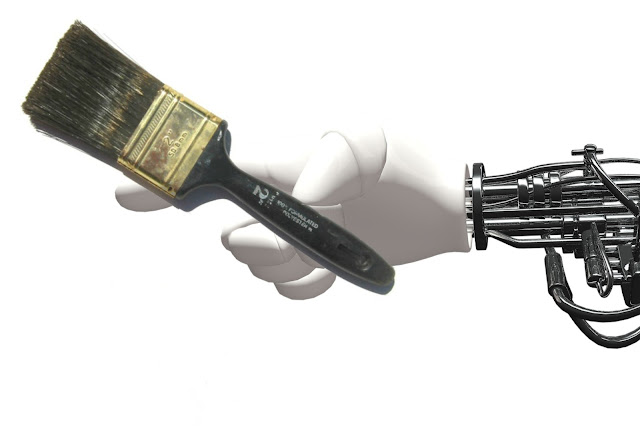
And that brings me to robots. The robots coming soon to your home, your department store, to doctors' offices and operating rooms, will be doing very complex tasks, very precise tasks. They will not be programmed to do these things, they will be set up to learn to do things and to do them better as time goes by. As they learn to do things for us, we will cease to learn to do them for ourselves because we will no longer need that knowledge. Once upon a time, teaching children how to shape stone tools was a vital skill for any human community. When was the last time anyone bothered to teach stone tool making to their child? So here is a question to consider. What happens to our fine motor skills when we no longer have to call upon them for tasks that matter, when we have wired homes and handy robots to take care of these things?
How will that reshape us?
I recently opened up my Globe and Mail to find a two page spread explaining how smart technologies created the picture displayed there of a man who never existed executed in the style of Rembrandt. The Globe and Mail called it a "frame worthy portrait." I don't know what to call it. An art fraudster's dream? Artish techno-crap? Abomination comes to mind, but maybe that's me channeling my Uncle Harry (see more on Uncle Harry below). Tu Thanh Ha, better known as a political reporter, gives us the story behind the image. The Dutch bank ING has apparently funded and supported public art for years. ING teamed up with the advertising moguls, J. Walter Thompson, to further advance its brand through the invocation of the greatest of all Dutch painters, Rembrandt. They asked leading technologists to whomp up something Rembrandtish for the public's enjoyment. So several leading experts brought to bear the smart technologies of the moment. All of Rembrandt's known portraits were subjected to facial recognition software and other clever tricks to arrive at a statistically representative Rembrandtish array of pixels.This data was used to direct a 3-D printer. The result approximates the cracked, bumpy, brush-stroked surface of a painting made four hundred years ago, though it presents the image of a man who never existed and so was never painted by Rembrandt. It is not painted at all.
Please look at it and tell me what you think. I see a clumsy, sad sack sort-of person with a floppy hat, sort-of hair, a sort-of potato nose, lifeless eyes, a ruff of the period, illuminated by light said to mimic Rembrandt's use of same. To my eye it looks like paint-by-number.
As my Uncle Harry would say, I am appalled. Only technologists would consider this a project worthy of the name public art, technologists utterly disconnected from what art is, and why we make it.
So what is public art anyway?
Long ago when I was small, my Uncle Harry had strong opinions on same. He was a famous man in our town, Saskatoon, Saskatchewan, a city of
nicknames including the Hub City, the City of Churches, the City of
Bridges, but not the City of Art, though that should have been one of
them.He was known as "Doc" because he fixed the broken bodies of cars. He was the second eldest and best known among his accomplished and equally opinionated siblings, because he had a knack for calling public attention to his points of view on everything -- pioneers, business, the need for another community swimming pool, the weather. "How hot is it? It's hot enough to fry eggs on the sidewalk!" the newspaper cutline would shout under a picture of my Uncle Harry frying an egg on the sidewalk on a sizzling day in July. Saskatoon had phone-in radio shows, and Uncle Harry often called in. He was an activist in things having to do with city governance, recreation, the pioneer experience, the rights of First Nations, anti-racism, and he also had strong views on civic art. Everybody in town knew his gravelly voice.
Now even then, when I was young, there were a lot of people in Saskatoon who knew from art. One of the leading businessmen in town, who had made a pile of dough in meat packing, was a major collector of the Group of Seven. In 1964, a beautiful, eponymous museum arose on the river bank to which Fred Mendel donated his works as a permanent collection. The Mendel was better attended in its prime than the Art Gallery of Ontario though the whole population of Saskatchewan was then (and is still) much less than half of Toronto's. There was -- is -- something about Saskatchewan that inspires visual artists and the love of same. The Emma Lake Artists' Workshop, which started as a summer school in the Thirties, took on the world in the Fifties when artists affiliated with the University of Saskatchewan (who were also part of an informal group known as the Regina Five), invited big name artists to come and do art on the shore of Emma Lake. Emma Lake is north of Prince Albert. That's north. The workshops were led by major majors (Newman, Stella, Noland, Judd, Olitski) and even by Clement Greenberg, then a leading critic in New York City. No surprise, then, that Saskatoon decided to commission a major work of public art in 1960 to grace its brand new City Hall.
My Uncle's opinion was not sought on this subject, and he was not pleased with the project selected. Why? It was not a sculpture of a guy on a horse or a gal with a man draped over her lap, it was not a human figure at all. It was a work in sheet metal cut into shapes reminiscent of farm equipment piled to suggest an ancient Mayan god of rain. Its title is Rainmaker. My Uncle Harry's view was that this was not art at all, or at least not something that the ordinary, every-day people of Saskatoon could possibly enjoy. It was something that could only appeal to the high-falutin' fools up at the University. Yet the public had to pay for it. Uncle Harry's egalitarian view was that public money should be spent on something that reflects public tastes. Starting with his.
So he made a big fuss. He called up a radio talk show to make his views known. This involved comparisons that were invidious. This was not art, this was....
Apparently this tradition of protest over public art continues in Saskatoon. In 2014, two shrink wrapped bales of garbage were purchased from an artist by the City for the sum of $4,300 and set out on the sidewalk. A local man covered it over with a tarp and affixed a note saying that public money should be spent on taking away the garbage, not adding to it.
But listen, these works were at least made by people with ideas that they wanted to get across, they were not just statistically enabled theft. Love it, hate it, advocate for it, or militate against it, a work of art surely should be, must be something that erupts first in the mind of a person determined to reach out to others by means of an image. It can never be the shallow reproduction of a style apprehended by a piece of software. Now I'm willing to believe that in the future, as intelligent robots wend their way through the world, they may one day make works of art that encapsulate or celebrate their particular experience and world view. But this is not that.
So listen up, ING. You will never get any of my spare change in your bank by re-branding yourself this way. This project of yours can never be ennobled by the word art. Even the paintings made by bored chimpanzees have greater value. Why? Because chimpanzees, unlike software and 3-D printers, have hearts and minds. They have feelings. They have ideas. They belong to communities and they want to share.
Right Uncle Harry?

Last week I wrote about an algorithm that beat the world`s leading human player of a game called Go. The algorithm learns from experience. It mimics how natural neural networks function, and it is augmented by an innovative twist known as deep learning which drives greater speed and efficiency. Neural network computing methods are the brainchildren of many, but deep learning is the purview of Geoffrey Hinton, formerly of the UK, now at University of Toronto. In 2013, Google bought a company that Hinton jointly owned with grad students which held the rights to a specific form of deep learning. Now Hinton splits his time between the University and Alphabet/Google's main California campus, just one more instance of leading edge science being dragged into the widening maw of what we once considered narrow commerce. Now commerce leads the way. [For more on the Hinton story see my last book, SMARTS.] Clever technological application of deep learning is advancing artificial intelligence research by leaps and bounds, though the idea of copying how neurons remember and learn (through increasing connectivity) dates back a very long way. Turing discussed the idea at a symposium in 1949. Attempts to design computers that mimic how humans learn went in and out of fashion over the next fifty years. A
leading American computer scientist, who helped direct the assembly of the human genome project, told me he began working on neural networks in the early 1980s. Hinton himself studied neural networks with a man who was convinced they were a waste of time.
Success with neural networks, in other words, has been achieved only after long years of failure, which is itself a reflection of the way humans learn.
Go requires inference, intuition, and vision, mental skills usually considered to be the sole province of smart humans, not algorithms. Yet the algorithm beat Sedol in four out of five tries. In a brief apres le deluge interview posted inside this Guardian story, Sedol said that before the first game, he was pretty confident that no machine could beat him. He was surprised to find himself losing. He only won game four because the algorithm made a mistake. This gave Sedol hope that he could also defeat the algorithm in game five. Although it made another mistake, the algorithm learned from it, corrected itself, and defeated Sedol in a way, he said, that no human being would have been able to do. After the games were over, the algorithm was awarded a 9th Dan, the highest level of attainment in competitive Go.
Which brings me to something almost as important as this artificial intelligence milestone -- the amazing algorithm known as the democratic process.
Even as Sedol was losing game five, Donald Trump was trouncing his competitors in Tuesday's Republican primaries, with the exception of Kasich who beat him in Ohio. This was an utterly dispiriting result for those in the upper reaches of the Republican Party who had hoped that if Rubio took Florida, and Kasich took Ohio, Trump would not get enough delegates to win on the first ballot at the convention. A second ballot, with the delegates free to change their votes, might permit the leadership to get a nominee more Republican in his opinions, more amenable to the interests of the Party's big backers. But now Trump holds the Party's future in his hands-- unless the Republican Party votes to free all delegates in the first round of voting. Trump has said that if anything like that happens, there will be riots. He is not the only one predicting them.
Much has been said about how Trump is lighting the bonfires of hatred in America as he chest thumps about shutting America's doors to all Muslims, deporting 11 million illegal migrants, getting Mexico to pay for a giant wall across the southern border. His dystopian vision appeals to fringe voters who have never been happy living in a neighborly way with anyone whose skin color is not lily white. But hatred alone is not why Trump is winning. His intuition about what ails America has taken him far beyond the simple calculus that there might be enough mean spirited folk in the US to lift him to office. It's what he has to say about the US economy that has attracted all kinds of other voters, not just that loony fringe. He's channeling the anger and despair of what entertainment executives used to call the fly-over zone, those places in the US that are not Los Angeles, New York, or Washington. Bernie Sanders has been doing the same in the Democratic primaries, although he has voiced the anger of the student-loan burdened young more particularly, and he doesn't drape his argument in xenophobic rhetoric.
These two are not the first "outsiders" to run for high office as voices of the voiceless. Remember Ross Perot? What is so fascinating is how, at certain turning points in the natural histories of democratic societies, communities push forward such champions, or perhaps I should say welcome them with open arms as soon as they say out loud what those "in charge" would prefer to suppress.The interaction between champion and community, the way they feed off each other, learn from each other, and find new directions together is a hugely complex group version of what our own individual neural networks do when confronting the world. This mega neural network calculates who will win key elections without anyone involved really understanding how this works or being able to predict outcomes.
Americans are angry, says Trump, because professional American politicians-- unlike him--have been bought and paid for by special interests who don't care a fig for the interests of voters. He speaks often, and loudly, about how he intends to make American corporations which have relocated their plants to low wage zones like Mexico, Viet Nam, Malaysia, and China, pay serious taxes to import finished products back to the US. In effect, he is saying he will make big business sorry for destroying the livelihoods of a generation of American workers in order to reduce costs and increase profits. Trump also wants to force major American corporations to repatriate
their ill gotten profits from the tax havens where they've stashed them,
places like the Cayman Islands, Bermuda, etc. He has mentioned Apple in particular in that context which I'm sure went down like a rubber donut in Silicon Valley.
His rant is the anti-Republican Rant, the exact opposite to the normal one shaped by the Koch brothers through their billions in donations to Republican PACs and think tanks. The normal Republican Rant promotes the notion that government is bad and taxes are worse and corporations should reign supreme.
Trump argues that it's the free trade deals that have enabled the devastation of the American middle and working classes and the consequent rise of the 1 percent. He says he wants to rip up trade deals that benefit big corporations and enemy countries. In effect, he is re-litigating a battle that was already old twenty years ago. Remember Perot's argument against free trade? Remember his warnings about "the giant sucking sound" that would echo across the land as American jobs disappeared to Mexico thanks to NAFTA?
Unfortunately, tearing up trade deals will not fix the problem that afflicts America now, and by extension all the rest of us in the western world. The problem is the onrushing technological future, not just the globalization of the economic system. No matter who becomes the next American President, as the Google/DeepMind algorithm has demonstrated, jobs will not return to the fly over zone. The auto industry will not get rid of its robots and rehire all those folk it let go over the last twenty years. Software will continue to replace lawyers and accountants and hedge fund executives, as well as marketers, reporters, editors and home care personnel. The giant sucking sound is already being heard in the tall towers of New York and Los Angeles, and in the back rooms in Washington. Humans will become ever more superfluous to the functional performance of our globalized economy. Even the jobs done by the 1 percent will eventually be done by intelligent machines, machines imbued with the capacity for inference, intuition, and vision thanks to new algorithms like the one displayed in Seoul.
Trump is standing eyeball to eyeball with the past instead of squaring up to the future.
He doesn't understand that the machines have already trumped him.
But the democracy algorithm gets it.


